1. What Is Content Syndication?
Content syndication b2b is the process of sharing your existing B2B content through third-party sites and media platforms.
B2B content marketing includes white papers, eBooks, webinars, case studies, and research reports. It helps the marketing team reach a larger, pre-qualified audience of decision-makers and thought leaders. This goes beyond your own website traffic over the long term.
B2B content syndication helps drive traffic with valuable content for your buyer personas. It also boosts search engine rankings for a specific piece of content.
In practical terms: you create a high-value asset. A content syndication platform shares it with tens of thousands of ideal buyers. It places it across trade publications, B2B media networks, and professional communities. It collects buyer details using gated forms. Then it sends those registrations back to you as marketing-qualified leads (MQLs).
For CMOs and demand generation leaders managing enterprise-level budgets, content syndication sits at the intersection of brand authority and pipeline generation. Done correctly, it delivers measurable pipeline impact beyond basic list building and provides increased brand awareness.
This approach finds in-market buyers who show intent by engaging with content related to their role and business needs. In short: content syndication helps you share your best content with your best prospects – at scale, with precision, and with measurable pipeline results.
2. How Content Syndication Works in B2B
The mechanics of B2B content syndication are straightforward. Execution separates high-performing programmes from wasted spend. Here is the end-to-end process:
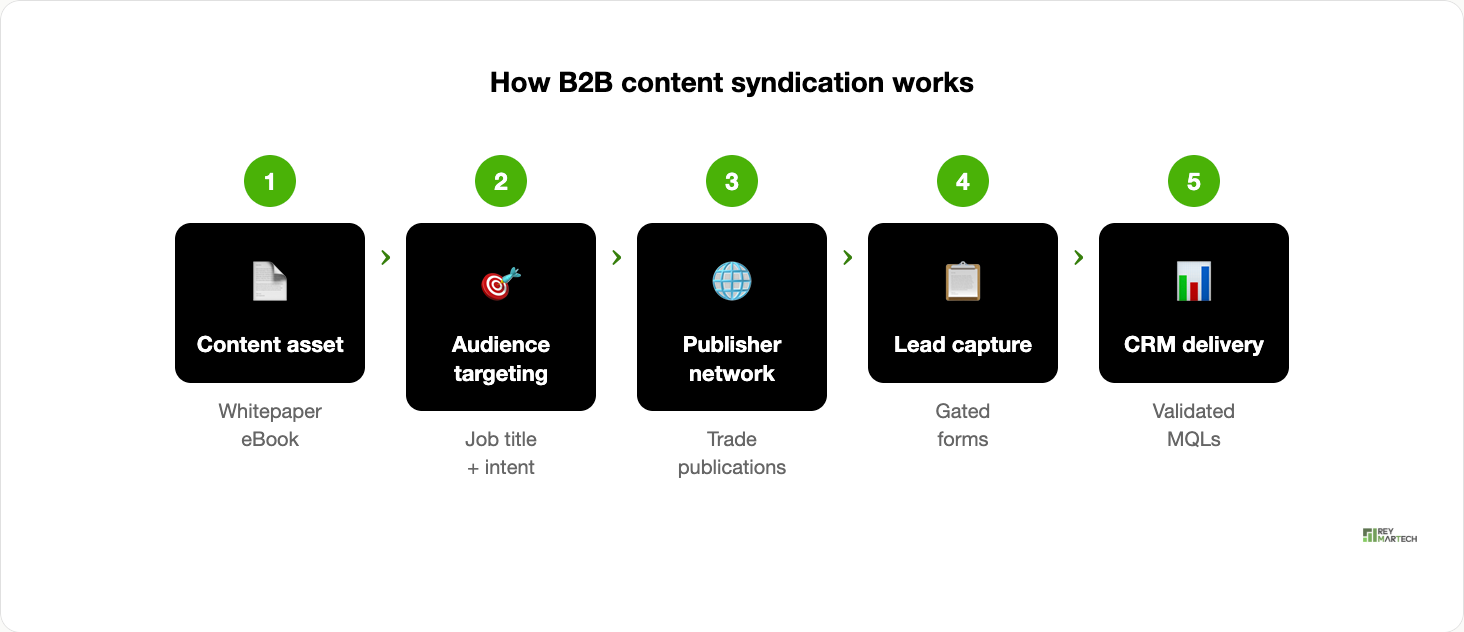
The five-step B2B content syndication process: from content asset selection through to validated MQL delivery.
3. Types of Content Syndication
Paid Content Syndication is the most common enterprise model. You pay a syndication network to share your content. They deliver a guaranteed number of leads that match your targeting criteria. This performance-based model ensures you invest directly in qualified leads rather than superficial impressions.
BANT-Qualified Syndication is a premium tier where leads are pre-qualified against BANT criteria (Budget, Authority, Need, Timeline) via telephone verification before delivery. Lead volume is lower, but conversion rates to sales-ready opportunities are significantly higher.
Intent-Driven Syndication targets accounts that show active buying signals. This approach dramatically improves lead quality by reaching buyers mid-funnel rather than cold.
Account-Based Syndication limits distribution to a defined target account list. This ensures your content reaches only the companies your ABM programme is pursuing.
Organic Syndication distributes content through free channels – LinkedIn articles, Medium, partner newsletters – with canonical tags to protect SEO equity. It is effective for brand building but lacks the precision targeting and lead capture mechanisms of paid syndication.
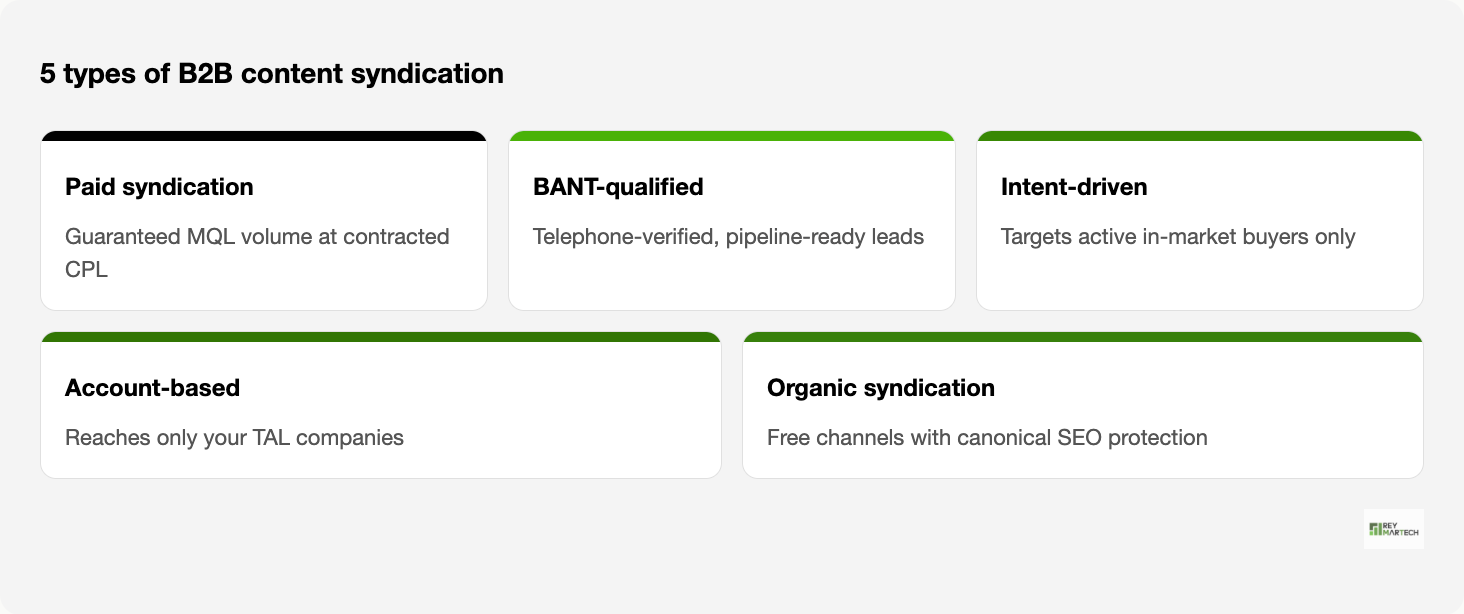
Understanding the five types of B2B content syndication helps enterprise marketers select the right model for their pipeline goals.
4. Why Content Syndication Matters for Enterprise B2B Marketers
- 65% of B2B marketers use content syndication as part of their demand generation mix
- Content syndication generates 3x the leads of outbound email at a comparable cost per lead for enterprise audiences
- Over 70% of B2B buyers consume multiple pieces of relevant content before engaging with a vendor
- ABM programmes using content syndication report 28% higher pipeline conversion rates
The strategic value extends beyond lead volume. Content syndication builds brand authority at scale. When your whitepaper appears on a leading technology or business publication, you borrow the credibility of that media brand. Decision-makers encounter your thinking in trusted environments – a halo effect that purely owned channels cannot replicate.
It accelerates pipeline for long buying cycles. Enterprise B2B deals involve 6-10 stakeholders and can take 6-18 months to close. Syndication keeps your brand and ideas in front of that buying committee throughout their research phase.
This approach captures valuable first-party data. Every registration is a clear signal of interest. These people chose to engage with your content. They are more open to follow-up than cookie-based retargeting audiences.
It also complements ABM with scale. A pure ABM strategy needs a lot of resources. Content syndication lets you run a broad top-of-funnel programme at the same time. It feeds your ABM target account lists with warm contacts showing intent.
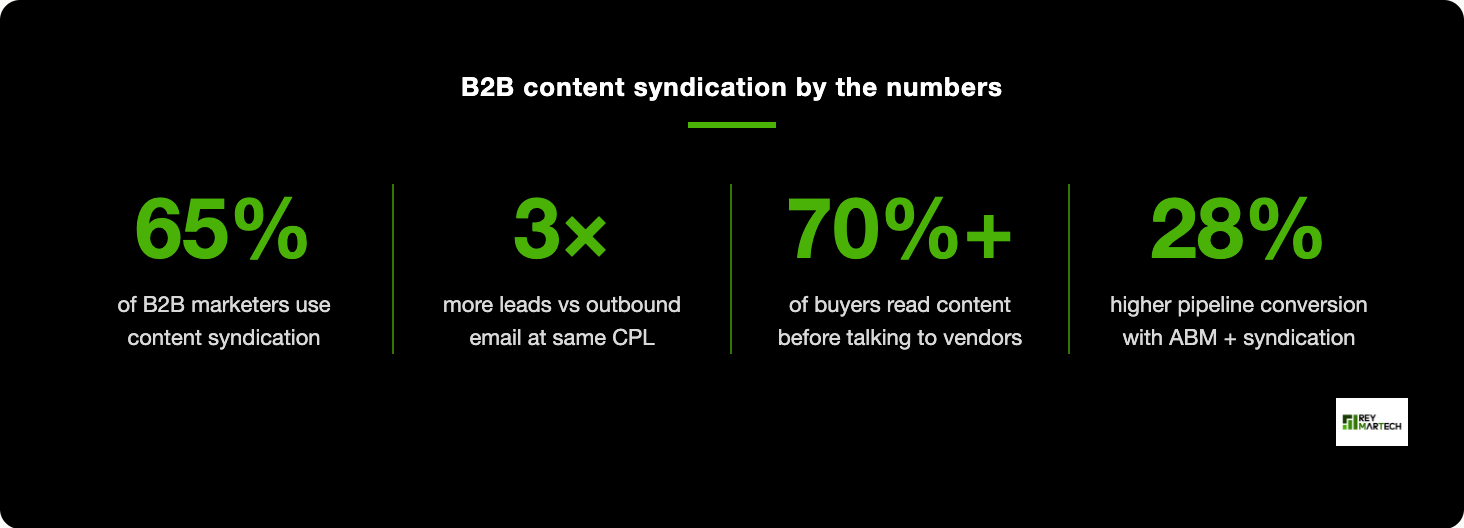
Content syndication integrates with ABM and demand generation to build consistent, measurable B2B pipeline.
5. Content Syndication vs. Content Distribution
These terms are often used the same way, but they have meaningful distinctions. Content distribution is a broad term. It covers any activity that puts your content in front of an audience beyond your own channels. This includes social media platforms, email newsletters, SEO, paid media, and syndication.
Content syndication is a specific subset. It uses a third-party network or publisher. It includes a gated content asset and a lead capture mechanism. Syndication aims to capture identifiable, qualified leads – not just impressions.
| Dimension | Content Distribution | Content Syndication |
|---|---|---|
| Primary goal | Awareness, traffic | Lead generation, pipeline |
| Output | Pageviews, impressions | MQLs, registrations |
| Lead capture | Indirect | Direct (gated forms) |
| Targeting | Broad | Job title, firmographic, intent |
| Measurement | Traffic, engagement | CPL, MQL volume, pipeline |
For enterprise B2B marketers with defined revenue targets, content creation feeds both – but syndication investment specifically drives accountable pipeline.
6. What Content Formats Perform Best in Syndication
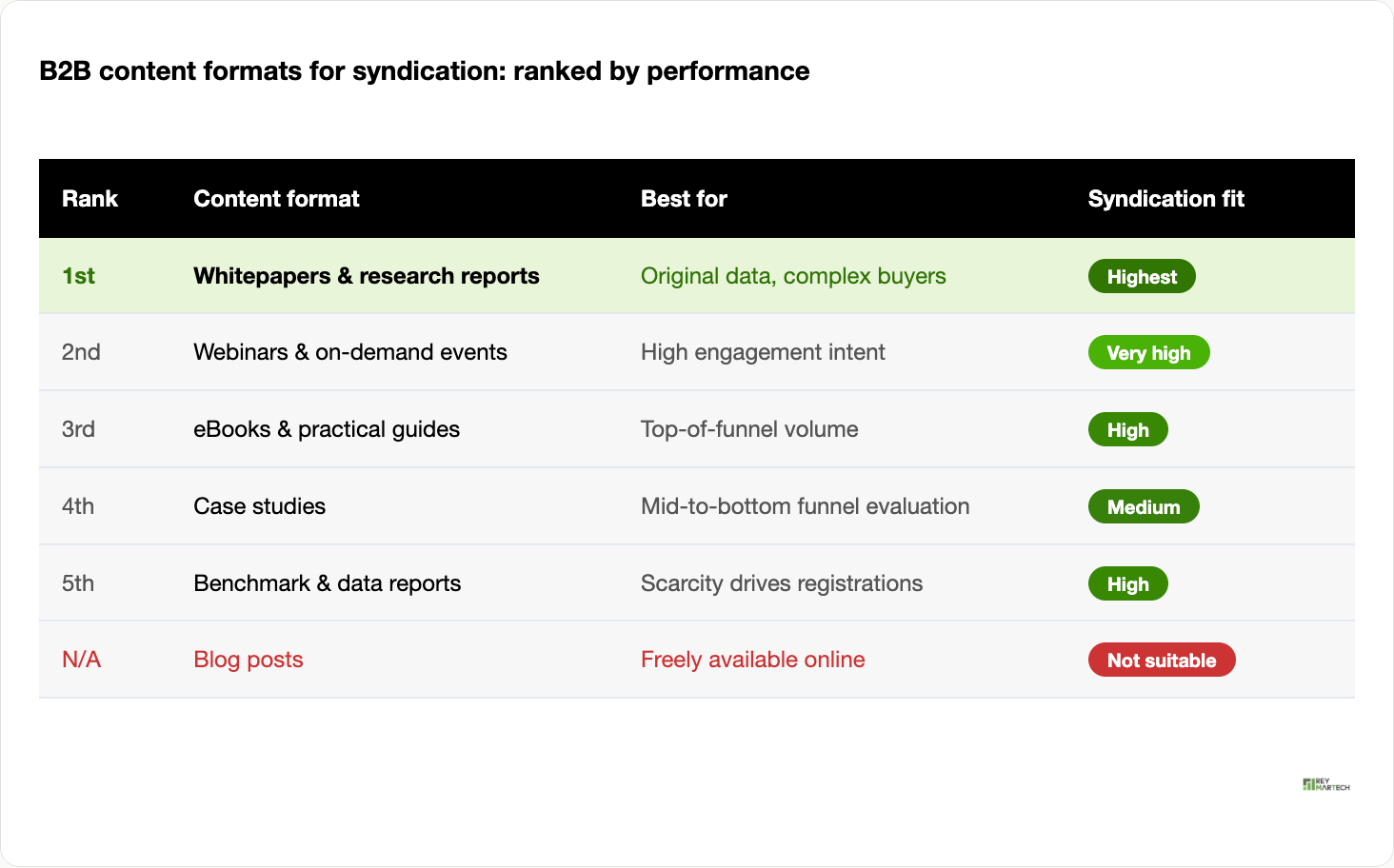
Whitepapers, webinars, and original research consistently deliver the highest registration rates in B2B content syndication programmes.
Whitepapers & Research Reports are the best overall format. They offer data-rich content addressing a strategic business challenge. Decision-makers register for original research they cannot find elsewhere. These assets are ideal for enterprise audiences with complex buying journeys.
eBooks & Practical Guides provide step-by-step, actionable content that helps buyers solve specific problems. They carry a lower barrier to registration and work well for top-of-funnel volume campaigns.
Webinar Recordings & On-Demand Events continue to gain ground in syndication. Prospects who register for a recorded webinar demonstrate higher engagement intent. These are particularly effective in APAC markets.
Case Studies & Success Stories drive mid-to-bottom funnel evaluation-stage engagement. Prospects who download a case study with the company name removed are signalling active consideration.
Industry Benchmarks & Data Reports consistently drive the highest registration rates. If your research is the only source of a key benchmark, buyers will register to access it.
What does not work: blog posts (freely available, no registration incentive) and product brochures (the audience is in research mode, not purchase mode).
7. How to Choose a Content Syndication Platform
Publisher Network Quality – Does the platform publish on media properties your ICP actually reads? A network of 200 premium, relevant publications outperforms one of 2,000 generic sites. Ask for the specific publishers where your content will appear.
Targeting Depth – Can you target by job title, seniority, industry, company revenue, headcount, and geography simultaneously? The more dimensions you use, the closer your audience fit.
Intent Data Integration – Does the platform incorporate intent signals to focus distribution on in-market accounts? Intent-driven syndication consistently outperforms standard demographic targeting.
Lead Validation Standards – How are leads validated? Look for phone verification, email hygiene checks, and IP validation. A platform delivering a smaller volume of highly accurate leads offers significantly higher business value than one delivering large volumes of unverified data.
BANT Vetting Options – For enterprise sales teams, telephone-verified BANT vetting is a significant advantage. Explore how BANT vetting works with content syndication.
Geographic Coverage – Confirm genuine publisher density in your target markets – particularly for APAC, where English-language B2B media audiences require specific regional expertise.
8. Regional Spotlight: Content Syndication Across Key Markets
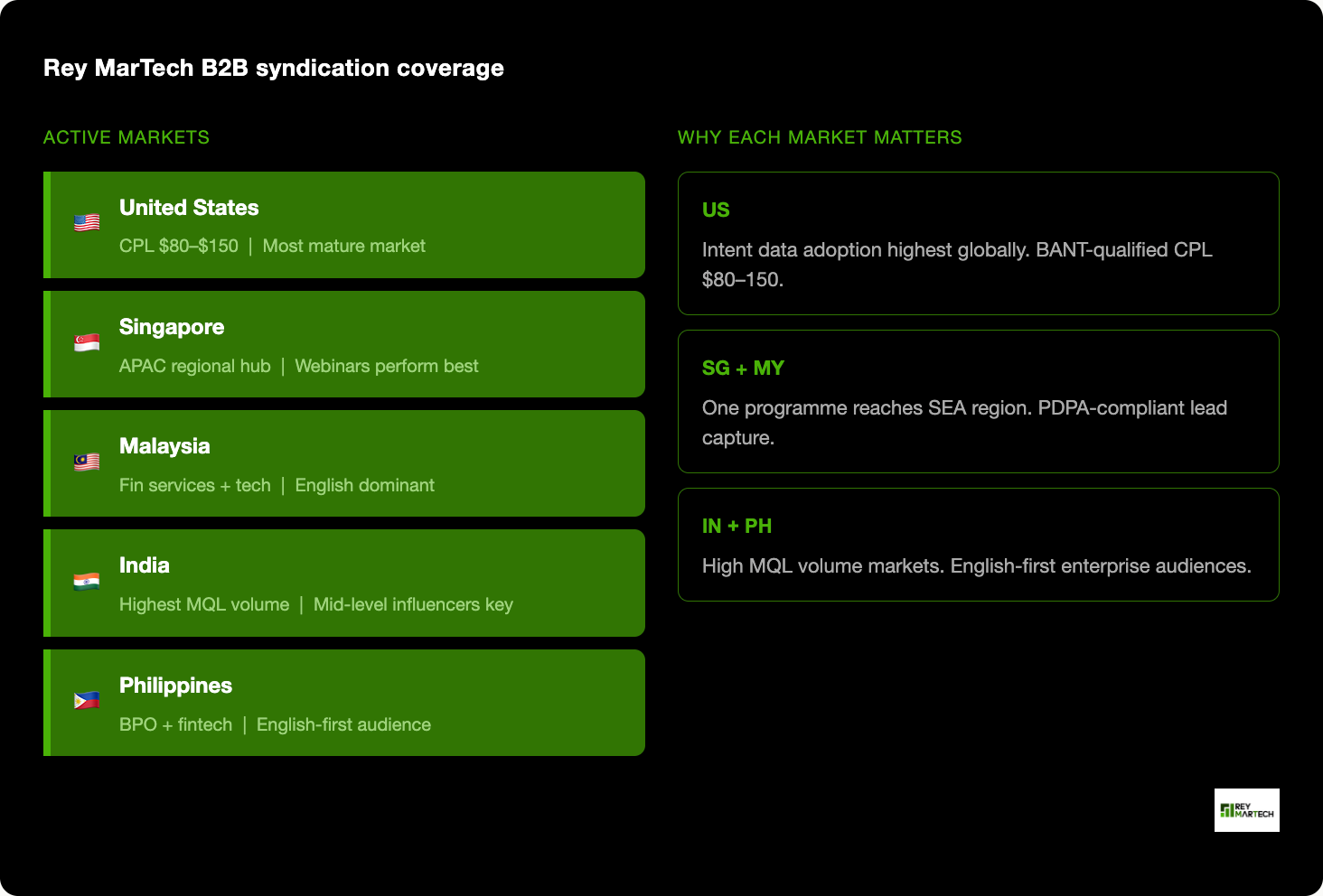
Rey MarTech operates specialist B2B publisher networks across Singapore, Malaysia, India, and the Philippines for regional syndication programmes.
United States
The US is the most mature content syndication market globally. Enterprise B2B buyers are sophisticated consumers of gated content. Whitepapers, research reports, and analyst content perform strongly. The average CPL for BANT-qualified leads is $80-$150. Intent data adoption is highest in this market, making intent-layered syndication standard practice for leading programmes.
Singapore
Singapore’s B2B market is compact but influential – decisions made here often govern Southeast Asian regional programmes. C-level and VP-level engagement is high for well-targeted content. Webinar recordings and short-form video syndication perform particularly well. Given Singapore’s role as an APAC hub, content that speaks to regional growth resonates strongly.
Malaysia
Malaysia offers a rapidly maturing B2B marketing landscape, particularly in financial services, manufacturing, and technology. Content addressing business efficiency, digital transformation, and cost savings performs well with Malaysian decision-makers. English-language B2B content remains dominant at the enterprise level.
India
India is one of the highest-volume B2B lead generation markets in APAC. Content syndication is growing rapidly, driven by the expansion of enterprise SaaS, cloud, and data protection procurement. India has many mid-level decision influencers. Content that speaks to both CXO strategy and hands-on implementation performs well.
Philippines
The Philippines is an emerging but high-potential market, particularly in BPO, financial services, and technology. Decision-makers are active B2B content consumers, particularly on LinkedIn and digital trade publications. English is the business language of choice.
9. How Rey MarTech Approaches Content Syndication
At Rey MarTech, we approach content syndication as a full-funnel, intelligence-led discipline – not a media buy. Our model integrates three core components:
Intent-First Audience Targeting – Every campaign begins with an intent layer. We use first-party and third-party intent signals to find accounts actively shopping in your solution category. Then we focus on distribution within those accounts.
BANT Vetting as Standard – For clients requiring pipeline-ready leads, we offer telephone-verified BANT vetting. Our team confirms each contact has budget authority, a clear need, and a near-term timeline. You then receive qualified leads delivered directly to your sales team.
Transparent, Validated Delivery – We do not deliver unverified lead data. Every lead passes through email hygiene, phone verification, and targeting-match checks before it reaches your CRM.
One Rey MarTech enterprise technology client in India ran a three-part ABM and content syndication programme across specialist B2B networks. The client achieved 101% more leads than the prior year. It also increased MQL-to-sales conversion by 23% and achieved a 7% reduction in cost per lead. Explore Rey MarTech’s lead generation services to understand how this approach could apply to your business.
10. Common Mistakes B2B Marketers Make
Syndicating the wrong content – Sending blog posts or product brochures through syndication programmes is a common mistake. Only gate and syndicate content that delivers genuine, exclusive value.
Ignoring lead validation – Accepting raw, unverified lead data from low-cost providers inflates MQL numbers while polluting your CRM. Always require lead validation as a contractual requirement.
Running with no intent layer – Content syndication without intent data is like fishing with a net in the ocean. Intent signals transform your targeting from demographic-based to behaviour-based.
Having no follow-up strategy – Syndication generates the lead. Your nurture strategy converts it. A lead not nurtured within 48 hours loses 80% of its conversion potential. Explore how email nurture and content syndication work together.
Ignoring APAC market nuances – Using a single US-centric content asset across all APAC markets is a missed opportunity. Localising examples and targeting parameters for each market greatly improves registration rates and lead quality.
11. Frequently Asked Questions
Want to see how a well-structured content syndication programme performs for enterprise B2B brands?
Explore Our Syndication Services →